

Toll Free:
1-877-270-9985, Phone:
519-653-1301, Fax:
519-653-2253
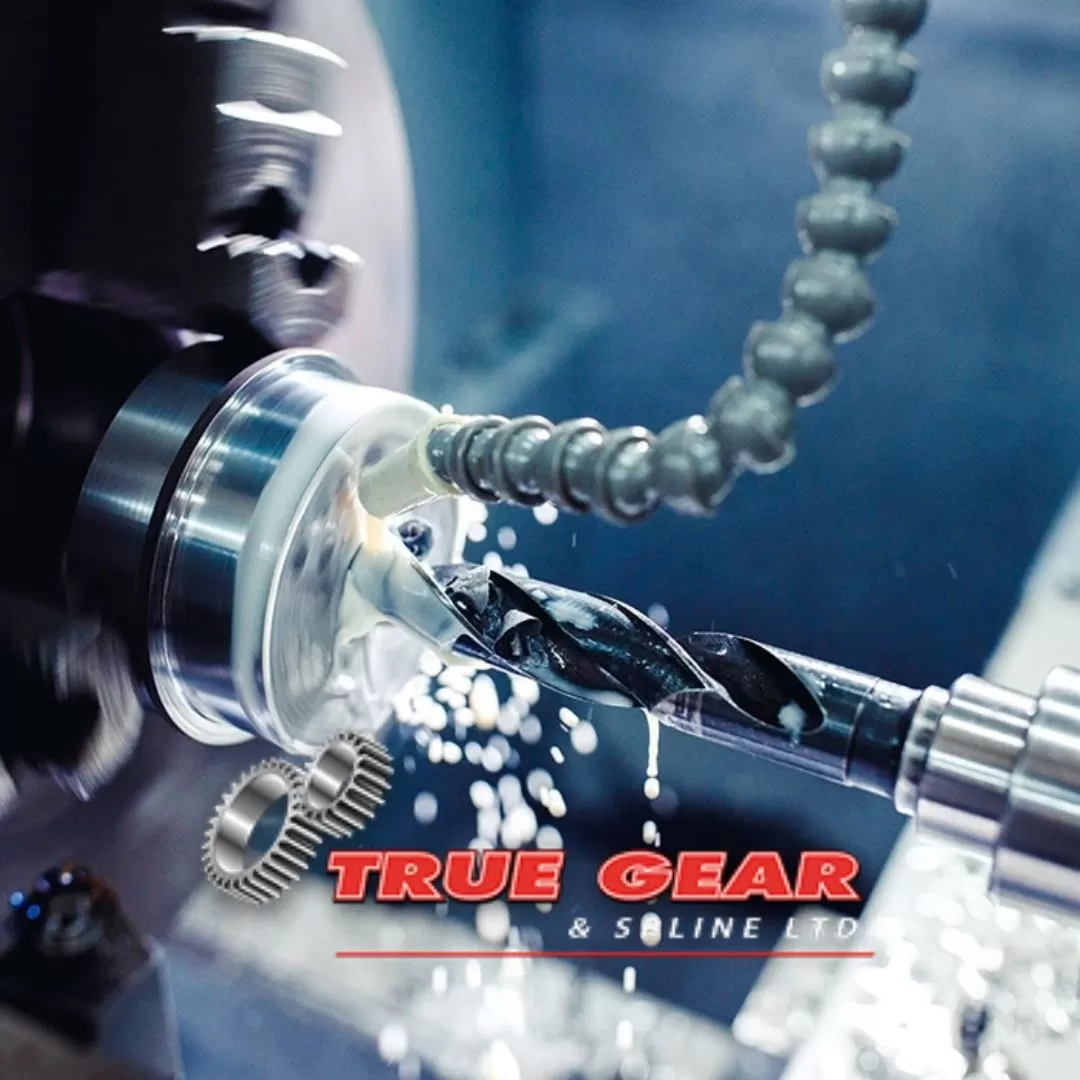
The gear manufacturing industry has undergone drastic changes in the last few decades. It has adapted to cater to the highly competitive modern industrial world. The use of CNC machining, sophisticated gear cutters, and advanced design software is common. True Gear & Spline Ltd. in Cambridge, Ontario, has 50+ years of industry experience, making us one of the most trusted names in Toronto and the GTA. If you are an engineer or business owner looking to partner with a gear manufacturer, read this blog till the end. By the end of this, you will have a full understanding of gear manufacturing processes, types, materials, and applications.
Gear manufacturing is the process of producing precise components designed to transmit torque according to specific client requirements. There are different types of gears, such as spur, helical, bevel, and worm, each with its own features and benefits.
An experienced gear manufacturer will take the time to understand your specific requirements before suggesting the best gear, manufacturing process, and material.
Gears transfer torque and motion by meshing their teeth, thereby transmitting rotational force from one shaft to another. The speed and torque can be adjusted to meet the end goal by changing the size, shape, number, and arrangement of the teeth.
This is why precision is unavoidable in gear manufacturing. Even the slightest deviation in design can compromise torque transmission and reduce overall production efficiency.
Gear manufacturing is an intricate process that involves many important steps. The manufacturing process is curated to meet the required torque, speed, load, and operating conditions.
This is the first step in the manufacturing process, where the design and manufacturing plans are made depending on the client's requirements. The design and the plan must precisely reflect the speed, torque, and load-capacity requirements. Extra attention is given to even minute details, as these design and manufacturing plans set the base for flawless gear manufacturing.
After the design is completed and the material is chosen, the gear cutting and tooth generation process. This is the physical act of cutting teeth into gear blanks. Gear hobbing, gear cutting, and gear shaping are some common methods of tooth generation. The ideal method depends on factors such as volume, expected turnaround time, and the material.
Gear grinding is used to fix microscopic irregularities on gear surfaces that might have occurred during tooth generation. It also helps correct heat-induced distortions, ensure accurate tooth spacing, and achieve tight dimensional tolerances.
Experienced and trustworthy gear manufacturers use advanced CMM technology to provide full gear analysis charts along with dimensional reports. This ensures the gears meet quality specifications and industry standards. Advanced inspection software helps minimize human error and ensures accurate quality verification.
Material selection is the most important step in a gear manufacturing process. The wrong material compromises a gear’s structural integrity, performance, durability, and efficiency. Here are some common materials used in gear manufacturing.
Carbon and alloy steels are known for their durability, wear resistance, balanced strength, and ability to be shaped into different gears. The cost-effectiveness, high tensile strength, and shock resistance are also reasons why carbon and alloy steels are commonly used for gear manufacturing.
Case-hardened gear materials include low-carbon steels, certain low-alloy steels such as 8620 and 9310. These materials are put through case-hardening processes such as carburizing or nitriding to create a wear-resistant outer shell and a tough core to facilitate shock absorption.
Stainless steel is the material of choice for gears that must function in high-moisture or corrosive environments. It is also ideal for chemically demanding environments. Specialty alloys are used to manufacture gears that might require special strengths such as tolerance to extremely high temperatures or improved wear resistance.
The standard industry practice is to choose a material based on application. What might work for one client might not necessarily work for another. Here are some of the most common factors that influence material selection:
Choosing the right material for the intended application requires careful evaluation of all these factors.
Several factors influence gear quality. If the gear manufacturing quality is compromised, it affects the gear's reliability, performance, and longevity. Here are some common factors that affect gear manufacturing quality.
A gear needs dimensional accuracy and tight tolerances to transfer torque smoothly. Even the smallest deviation can increase friction and cause premature wear and tear. This, in turn, adds to maintenance and repair costs.
Tooth profile is the cross-sectional shape of a gear tooth as seen in the plane of rotation. It is the shape of a gear tooth along its flank and face. Involute, cycloidal, straight-sided, and circular-arc are the most common tooth profiles. Surface finishing also plays an important role in reducing friction, facilitating smooth movement, and preventing premature wear.
Heat treatment, when done right, improves the gear’s wear resistance and efficiency. However, if the heat treatment goes wrong, it distorts the gear and compromises the structural integrity. Choosing the right heat treatment process, based on the gear type and material, is very important.
The expected load, speed, and operating conditions must be carefully evaluated to ensure high-quality gear manufacturing. These factors influence the choice of material, tooth design, heat treatment, and finishing process.
Quality inspection is crucial for verifying that the finished gear meets the required specifications. Not having accurate quality-inspection equipment in place compromises gear manufacturing quality.
Choosing the right precision gear manufacturing partner is essential for producing high-quality torque transmission components. Here’s what to consider when selecting a gear manufacturer.
A gear manufacturer must possess the right manufacturing capabilities to deliver high-quality gears on time. Verify if the gear manufacturer has advanced CNC machinery along with CMM for quality inspection and dimensional verification. The expertise of the team is just as important as the equipment. Take the time to assess the experience, technical knowledge, and capabilities of the manufacturer’s employees.
As already mentioned, it is important to verify if the gear manufacturer has an advanced CMM for full gear analysis charts as well as dimensional reports. Understanding the entire process will give you an idea of how seriously the gear manufacturer takes quality control.
Having clear goals and communicating your expectations clearly helps avoid last-minute confusion. It is important to work with a gear manufacturer who can deliver the expected production value within your expected lead time. At the same time, quality should not be compromised to achieve quick turnaround time.
Engineering and customization support are crucial to ensure high-quality gear manufacturing. You, as a business owner, might need professional consultation and advice on which gear type and material to choose for optimal results. An experienced gear manufacturer has engineering teams that take the time to understand your requirements.
True Gear & Spline Ltd. in Cambridge, Ontario, is an experienced gear manufacturer with 50+ years of experience. We have worked with aerospace, agricultural, automotive, defence, marine, and chemical industries and delivered countless torque transmission solutions.
Our state-of-the-art facility is equipped with the best CNC gear grinding, cutting, shaping, and machining equipment. The fully certified Zeiss CMM with Calypso and GearPro software ensures quality assurance. Whether you want us to manufacture custom spur gears, helical gears, splined shafts, or gear couplings, we will get the job done. Call 519-653-1301 to get a free quote today.
The gear manufacturing process involves defining gear requirements and specifications, selecting the right material, developing the gear design, machining the gear blank, tooth-cutting, heat treatment, surface finishing, and quality inspection.
Carbon and alloy steel, stainless steel, cast iron, and brass are commonly used materials for gear manufacturing.
Gear shaping is suitable for producing gears with specific design requirements and can also be used for internal gears. Gear hobbing is apt for manufacturing external gears, while gear shaping is ideal for manufacturing internal gears and those with specific design requirements.
Precision gears are inspected using CMMs (Coordinate Measuring Machines) and advanced software modules.
You choose the right gear manufacturing partner by reviewing manufacturing capabilities, checking quality & inspection processes, considering production volume & lead times, and evaluating engineering support. True Gear & Spline Ltd. in Cambridge, Ontario, is one of the most trusted gear manufacturers in the region. Call 519-653-1301 to get a free quote today.
Request a quote today and discover why industries across North America trust us for their gear manufacturing needs.