
Keep up to date with us on the latest industry news as well as what's going on at True Gear & Spline Ltd. We also post articles for insider tips and tricks, so make sure to check back frequently.
How Gear Hobbing Improves Precision Gear Manufacturing
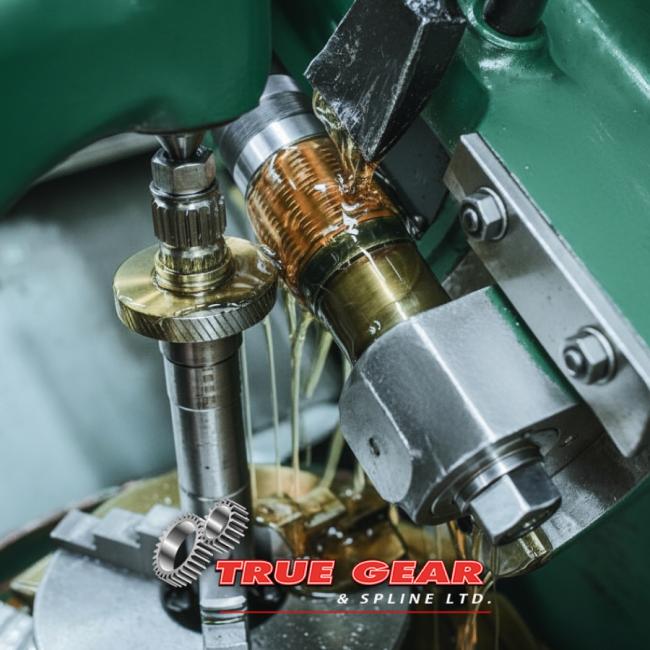
Precision manufacturing is the key to success in the current industrial environment. In today’s highly competitive market, there is barely any scope for error. Gear manufacturing is one such industry that must always achieve perfection, no matter what. Any lapse could compromise the precision of torque transmission components. This, in turn, could set in motion a chain of events that compromises product quality.
There are many different gear manufacturing techniques. However, nothing quite beats gear hobbing in precision. It uses a specialized tool called the hob to cut teeth into cylindrical blanks. The blank and the hob both move in synchronization to manufacture gears, splined shafts, and sprockets with unmatched precision. The hob head, work spindle, feed mechanism, and indexing mechanism are the key components of gear hobbing.
Many businesses across industries rely on gear hobbing services from True Gear & Spline Ltd. in Cambridge, Ontario, to manufacture gears with consistent quality and efficiency.
Why Gear Hobbing Is Preferred for Precision Gear Manufacturing
Gear hobbing is among the most preferred gear manufacturing techniques. If you are wondering what is behind this unmatched precision and accuracy, continue reading. We discuss it briefly to help you make the right decision.
High production efficiency and repeatability
Modern gear hobs are equipped with CNC technology. This means all the operator has to do is input specific instructions using the touchpad, and the gear hob will follow them to the last detail. The use of CAD software further helps prevent errors, even before the gears enter production. Because of these factors, gear hobs guarantee high production efficiency and repeatability.
Precision tooth profile generation
A gear is only as good as its tooth profile. An inaccurate tooth profile causes unnecessary problems, such as vibrations and noise. Gear hobbing guarantees the perfect tooth geometry that promotes gradual engagement and precise tolerance. This precise tooth profile generation also means reduced wear and minimal maintenance.
Faster machining for high-volume production
Time is of the essence for businesses. If you are looking to get a large batch of gears or splined shafts manufactured on a tight deadline, you are better off relying on a gear-hobbing service from an experienced gear manufacturer. Sophisticated gear hobs facilitate faster machining and are perfect for high-volume production. The absence of errors means no need for expensive and time-consuming rework.
Ability to manufacture complex gear geometries
No gear geometry or tooth profile is off-limits for sophisticated gear-hobbing machines. If it can be designed on the CAD software, it can be manufactured. This means you can safely rely on gear hobbing services for custom torque transmission components.
Reduced material waste and machining time
The precision of gear hobbing results in minimal material wastage. The machine removes from the blank only what is absolutely required to meet the client's requirements. This directly translates to lower costs, quick turnaround time, and maximum efficiency.
Checklist: Benefits of Gear Hobbing
- High dimensional accuracy
- Faster production cycles
- Consistent tooth geometry
- Reduced manual intervention
- Better scalability for mass production
- Efficient machining of multiple gear types
Types of Gears Produced Through Gear Hobbing
The versatility of gear hobbing is one of the factors that make it an attractive option. Here are some of the most common gears produced through hobbing.
Spur gears
Spur gears are among the most common torque transmission components. Their popularity can be attributed to their simple design and reliable performance. Gear hobbing service can be trusted to manufacture both external and internal spur gears with perfect tooth geometry.
Helical gears
Helical gears are similar to spur gears in design, except for one major difference. While spur gears have straight teeth, helical gears have slightly curved teeth. The teeth are set at the helix angle, giving helical gears their name.
Worm gears
A worm gear, often used as part of the worm drive, is used to reduce speed while increasing torque. Gear hobbing is the manufacturing technique of choice for worm gears due to the precision it offers.
Splines and sprockets
Whether you want to source splined shafts or sprockets, gear hobbing can get the job done. Thanks to CNC technology and the versatility of gear hobs, you can pretty much manufacture any torque transmission component using gear hobbing services.
Step-by-Step Gear Hobbing Process
Gear hobbing involves much more than what meets the eye. It demands meticulous planning and execution to ensure precision manufacturing. Here is a step-by-step breakdown of the gear hobbing process.
Step 1: Material selection and preparation
First and foremost, gear manufacturers select the appropriate material depending on the intended application. Factors such as expected load, environment, torque, and speed are considered to choose the right material. Here are some of the most common materials used for gear manufacturing:
- Carbon steel
- Alloy steel
- Stainless steel
- Brass
- Aluminium
After selecting the material, it is cut into the required size and prepared to get rid of dust, debris, grime, and oil that might affect gear hobbing precision.
Step 2: Hobbing machine setup
Setting up the hobbing machine correctly is important to avoid any mishaps during the manufacturing process. The operator inputs the required instructions on the control panel. Securing the workpiece onto the spindle is one of the most important tasks while setting up the machine.
Step 3: Hob cutter selection and alignment
Gear manufacturers usually boast a wide range of hob cutter selection. Choosing the right hob, depending on the gear to be manufactured, is extremely important for precision. Once the hob is selected, it is secured and aligned with the workpiece to ensure optimal results.
Step 4: Gear cutting and indexing process
Sophisticated gear hobbing machines get the job done seamlessly. The hob and the workpiece both move in synchronization to cut the perfect teeth. Automatic indexing makes life easier for the operators and guarantees precise tooth geometry.
Step 5: Inspection and quality verification
Gear manufacturers have inspection procedures and quality checks in place to ensure precise tolerance and seamless torque transmission. We at True Gear & Spline Ltd. use Zeiss CMM with Calypso and GearPro Software to ensure the utmost quality.
Step 6: Secondary finishing operations
Surface finishing processes such as deburring, grinding, heat treatment, or surface coating may be performed to improve durability, wear resistance, and overall gear quality.
Conclusion
Gear hobbing, when done right, improves efficiency, precision, and guarantees productivity for industries. True Gear & Spline Ltd. in Cambridge, Ontario, is a one-stop destination for all your gear manufacturing needs. We offer gear hobbing services to clients in Toronto and the GTA at unmatched rates. Call 519-653-1301 to talk to us today. We manufacture custom gears, splined shafts, and couplings for a wide range of applications.