Toll Free:
1-877-270-9985, Phone:
519-653-1301, Fax:
519-653-2253
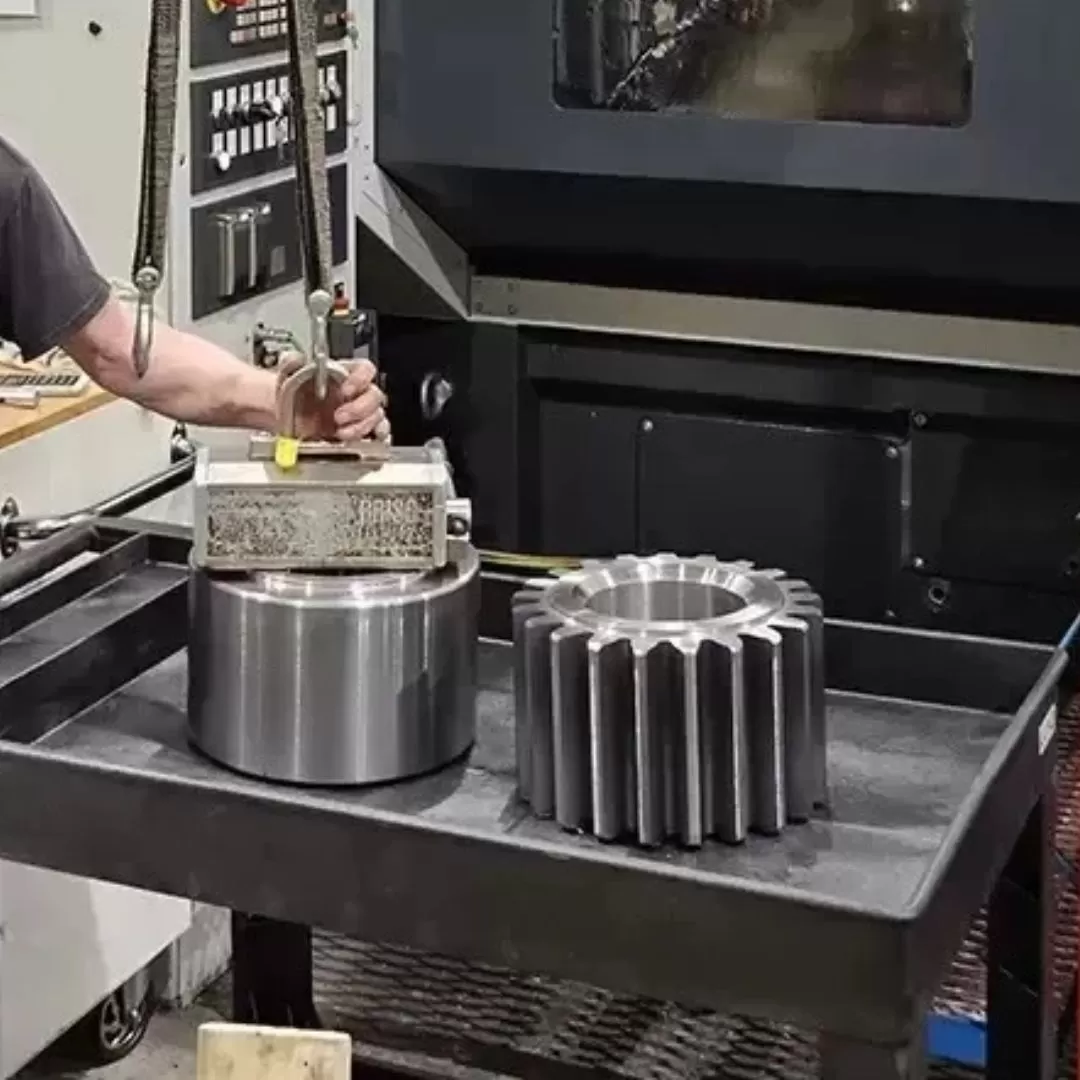
Gear shaping is one of the most fundamental parts of gear manufacturing. Sophisticated CNC gear shapers have the ability to manufacture a wide range of custom gears, including internal & external splines, spur gears, internal gears, helical & double helical.
Automotive, aerospace, defence, heavy machinery, robotics, and power generation are some large-scale industries that rely on gear shaping.
A gear shaper uses a reciprocating cutter that moves across the gear blank to ensure a precise tooth profile. If you are in the market for a gear shaping expert, read this blog first. Here, we explain the process, applications, benefits, and limitations of CNC gear shaping so you can make an informed decision.
Gear shaping is a gear manufacturing process that uses a gear-shaped cutter to generate teeth on a gear blank with precise tolerances. The cutter in the gear-shaping machine moves in a reciprocating motion with utmost precision to generate teeth on gear blanks. Both the cutter and the workpiece move in a synchronized fashion to manufacture flawless gears.
As already mentioned, gear shaping works by moving the cutter in a reciprocating motion. With each synchronized stroke, the cutter removes a bit of the material from the gear blank. The same movement is repeated until the gear is fully ready.
Depending on the type of gear being manufactured, cutters of different geometries might be used. Disk-type, hub-type, shank-type, and helical are different types of cutters used for gear shaping.
As one of the popular gear-manufacturing processes, gear shaping is highly sought after. Especially when it comes to cutting internal teeth and creating complex configurations that other gear-manufacturing techniques cannot achieve, gear shaping is often the preferred method.
Without further ado, let’s take a look at how the gear shaping process works. We briefly highlight the step-by-step process of gear shaping.
Once the gear material is decided based on the intended application, the gear blank is prepared. It is machined to the basic dimensions before cutting teeth into it using the reciprocating cutter.
The alignment between the workpiece and the cutter determines how efficiently the teeth are cut into the blank. Misalignment not only damages the workpiece and the cutter, but also causes unnecessary delays and material wastage. Once the gear blank is prepared, it is safely positioned and secured in proper alignment with the cutter. The cutter is selected depending on the tooth count and other design requirements.
In gear shaping, the cutter and the workpiece move in a synchronized manner. This synchronization is the key to efficient tooth cutting in gear blanks. The cutter in a gear-shaping machine moves in a reciprocating manner, and with each movement, it removes material from the gear blank until the gear tooth is perfectly cut.
Once the desired tooth profile is cut into the blank, the next step is to control the tooth geometry and helix angle. The cutter, machine settings and workpiece positioning must all be selected according to the gear drawing and specifications.
Once the tooth generation is complete, finishing touches are applied to ensure precise tolerances. Gear grinding or even heat treatment might be the next step involved in the finishing process.CMMs and advanced software are used for inspection to ensure the gear is exactly how the client wanted it to be.
Before completing a gear-shaping job, manufacturers do the following to ensure precise tolerances and top-notch quality.
Continue reading to learn how gear shaping fares against some of the other popular gear cutting processes. Understanding these differences can help you choose the right gear-cutting process for your specific application.
Sophisticated gear hobbing machines are widely used to cut external gears. The cutter, called the hob, works by continuously cutting gear teeth into the blank. Meanwhile, the cutter in a CNC gear shaping machine works in a reciprocating manner. Gear shaping is extremely useful for cutting external gears.
Gear milling uses a specialized cutter, called the milling cutter, to cut the space between two teeth. In gear milling, the workpiece and the cutter are both rotating. The shape of the cutter’s edge depends on the shape of the space between the gear teeth to ensure accuracy.
Gear milling is perfect for manufacturing specialized gears, prototypes, or low-volume applications. Gear shaping is more versatile as it is used for manufacturing internal and external gears. Another primary difference is in the movement of the cutters. In gear shaping, the cutter moves up and down, while in gear milling, the cutter moves axially.
Gear shaping is not actually a gear manufacturing process. Rather, it is a finishing process where any imperfections are addressed. It is used to address microscopic variations to ensure precise tolerances and flawless gear finishing.
The right gear manufacturing process depends on various factors such as the intended application, turnaround time, volume, budget, and the material. An experienced gear manufacturer will understand your requirements before suggesting the right gear manufacturing process.
Gear shaping offers certain significant benefits that make it the go-to technique for certain applications. Here are some of the most impressive benefits of CNC gear shaping.
Thanks to CNC technology, the precise movement of the cutter ensures flawless geometric accuracy. No matter how complex the gear geometry or tooth profile is, gear shaping can achieve it without any deviation from the original design.
Whether you want to manufacture ten gears or a thousand, CNC gear shaping ensures consistency and repeatability. Once the CNC gear shaper is correctly programmed, it can manufacture as many gears as you want to.
The ability to produce both internal and external gears makes gear shaping one of the most flexible gear manufacturing methods. Where other gear manufacturing methods fail to yield results, gear shaping gets the job done.
Whether you want to manufacture prototypes or a large batch of gears, gear shaping gets the job done. It is ideal for different production volumes with guaranteed perfection.
True Gear & Spline Ltd. in Cambridge, Ontario, is a trusted gear manufacturer that also offers gear shaping services. We use 2 Mitsubishi ST40 shapers and a Pfauter PSA500 to achieve flawless CNC gear shaping. Our capability to handle both small and large batches with equal precision is unparalleled. The experienced and talented team at True Gear and Spline Ltd. will work with you throughout to guarantee precise tolerances, customer satisfaction, and turnkey solutions. Call 519-653-1301 today to get a free quote.
Gear shaping is used to manufacture external and internal gears with precision and consistency. It is a reliable method to produce gears with complex geometries.
Gear hobbing uses a continuous cutter, called the hob, while gear shaping uses a reciprocating one. Gear hobbing is particularly useful for manufacturing external gears, while gear shaping is more suitable for internal gears and those with complex geometry.
Yes, gear shaping can produce internal gears.
Yes, sophisticated CNC gear cutters are suitable for high-volume production. Gear cutters help achieve consistency and repeatability.
Gear shaping can produce several configurations, including internal and external gears, spur gears, helical gears, double-helical gears, and involute splines.
Request a quote today and discover why industries across North America trust us for their gear manufacturing needs.