

Toll Free:
1-877-270-9985, Phone:
519-653-1301, Fax:
519-653-2253
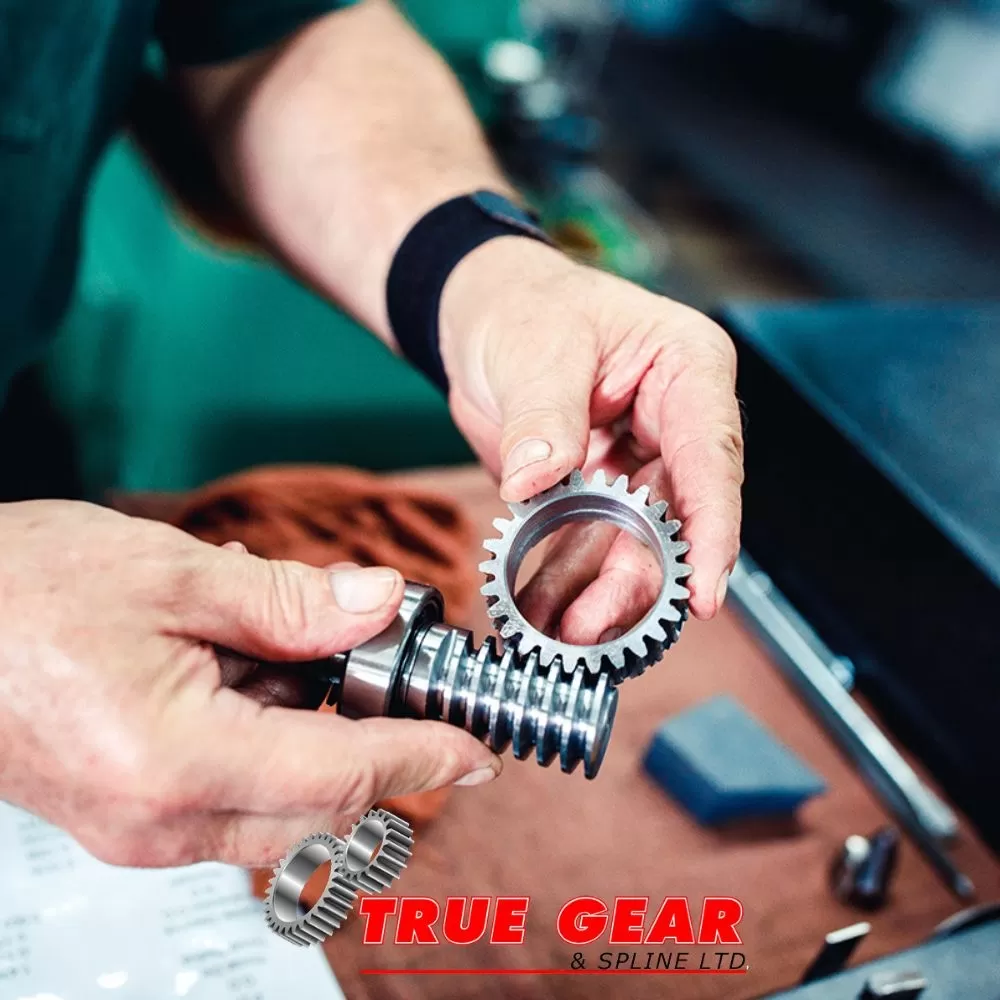
Backlash in gears is the intentional space between mating gear teeth. Accurate gear backlash is critical to the gear's performance and longevity. Too little backlash causes damage to the gear, and excessive backlash contributes to power loss during torque transfer.
Gear backlash is the intentional space between two mating gear teeth. The backlash is generally small for applications that require precision. More backlash is generally suited for high-speed applications, such as in gearboxes and industrial pumps.
Two mating gears have an intentional space between their teeth. This space is called backlash. When the rotation of the gear is reversed, the two teeth take a bit of time to make contact due to the backlash. This means there is usually a movement in one gear (the driving gear being reversed), before there is a corresponding movement of the driven gear.
Backlash is just one of the factors that might cause lost motion. Other factors include shaft deflection, bearing movement, and structural compliance. In simple words, backlash is the gap between the mating gear teeth, while lost motion is the accumulated lag in the gear or mechanical system. Both backlash and lost motion are part of basic gear terminology that you must be familiar with.
| Aspect | Gear Backlash | Lost Motion |
| Definition | Clearance between mating gear teeth | Input movement not immediately reflected at the output |
| Common Causes | Tooth clearance, wear, incorrect gear positioning | Backlash, shaft deflection, bearing movement and structural compliance |
| Practical Implication | Can delay motion transfer during reversal | Can reduce the overall positioning accuracy of a mechanical system
|
Gear backlash is intentionally designed to accommodate manufacturing tolerances and dimensional variation. The backlash has to be just right to ensure uninterrupted torque transfer and gear longevity. Here are some other reasons why gears need backlash.
Accommodating Thermal Expansion: Heat generated during operations causes the gears to expand in size. Depending on the gear material and operational environment, the backlash is set to accommodate thermal expansion.
Supporting Lubrication: Backlash in gears allows lubricants to settle and helps gear teeth move smoothly without excessive friction.
Prevents binding: Without the required backlash, there’s a risk of gears being too close to each other. This lack of space can cause the gears to stop moving smoothly or lock them up completely
This is why the goal of gear manufacturers is never to eliminate backlash entirely. Rather, to ensure the perfect backlash depending on the gear type and intended application.
Here’s the cause-and-effect table where each cause of excessive gear backlash is linked to its likely mechanical effect and a practical inspection point.
Possible cause | Likely mechanical effect | Practical inspection point |
| Tooth wear or damage | Increased or inconsistent clearance | Examine tooth surfaces for wear, pitting and chipping |
| Incorrect centre distance | Excessive clearance or poor engagement | Check shaft spacing against design specifications |
| Bearing or shaft wear | Changes in gear position | Check bearing condition and shaft play |
| Assembly errors | Uneven tooth contact | Verify mounting, alignment and component seating |
| Incorrect gear selection | Unsuitable tooth engagement | Confirm gear specifications and compatibility |
| Demanding operating conditions | Accelerated wear or damage | Review loads, reversals, lubrication and operating history |
Gear Tooth Wear and Damage
Natural wear and damage due to continuous operation can cause excessive backlash. As the material gets chipped away slowly, the space between the meshing teeth naturally gets bigger.
Incorrect Gear Positioning
The distance between two gear shafts has to be as per the recommended specifications. Incorrect distance between the centres of the gears causes excessive backlash.
Shaft or Bearing Wear
Just like gear tooth wear, shaft and bearing wear also lead to excessive backlash.
Misalignment Due to Assembly Error
Gears, shafts, bearings, and couplings must all be aligned carefully as per the specifications to prevent misalignment.
Manufacturing Variations
Even the slightest deviation in the tooth geometry can lead to excessive backlash in gears. This is why gear manufacturers use advanced technology to ensure precise tolerances and verify backlash.
Excessive backlash is not very easy to verify. For example, noise, vibration, and inconsistent movement alone do not verify excessive backlash. These problems can also be because of damaged teeth, improper lubrication, misalignment, or bearing/shaft problems. Here is an inspection checklist that can help you distinguish backlash from other gear problems.
Understanding the causes of gear failure is important to distinguish backlash from other gear problems.
Excessive gear backlash affects torque transfer between gears in more ways than one. Here’s a table that clearly links performance effects to the potential consequences. Continue reading to learn all about how excessive gear backlash compromises performance.
Performance effect | When it matters most | Potential consequence |
| Reduced positioning accuracy | CNC machinery, indexing systems and robotics | Delayed or inconsistent output movement during reversal |
| Increased noise | Gear drives with frequent changes in direction | Audible impact as tooth flanks engage |
| Vibration and impact loading | Systems operating under changing torque | Repeated impacts that may affect smooth operation |
| Accelerated wear | High-load or frequently reversing drives | Progressive tooth damage and changing clearance |
| Reduced motion consistency | Precision transmission systems | Difficulty maintaining repeatable movement |
Backlash in itself is not problematic. The problem is when the backlash is inaccurate and creates a problem with torque transfer rather than complementing the gear’s operation. Which brings us to the next section: When does backlash become a problem?
As already mentioned, backlash in itself is not the problem. It becomes a problem when the backlash is too little or excessive for the intended application. There is no one way to gauge the correct backlash. However, continue reading for a decision framework to help you evaluate acceptable backlash based on design requirements.
High-Precision Applications: Robotics, CNC machining, semiconductor handling equipment, and aerospace and defence applications require gears to have tight or zero backlash. Even the smallest lost motion can compromise accuracy.
General Industrial Drives: More generic applications such as transmission systems, conveyors, and pumps have greater flexibility for accommodating backlash variations. However, it can be a problem if the backlash isn't within the limits suggested by the gear manufacturer.
Systems with sudden changing performance: A sudden change in backlash and gear performance might be due to bigger problems with the gears. The problems must be found out and addressed quickly to prevent performance from worsening.
As there is no universal threshold for the right backlash in a gear, each case must be carefully evaluated to find out plausible causes and the best-case solution.
Many issues that ultimately lead to backlash problems can be fixed with the help of proper gear design and manufacturing. Only an experienced gear manufacturer has the knowledge and equipment to ensure precise tooth geometry, component consistency, and immaculate assembly.
Take True Gear & Spline Ltd. in Cambridge, Ontario, for example. Our precision spur and helical gears are perfect for engineers evaluating gear components. The very experienced team at True Gear & Spline Ltd. takes the time to understand application requirements, loading, alignment, and precision expectations before manufacturing custom gears. We also offer precision gear grinding and CNC machining services to guarantee everything is made as per client requirements.
Backlash in itself is not a problem. However, it becomes a problem when backlash in a gear is too little or excessive.
Backlash in gear could be due to different reasons, including wear, misalignment, or improper gear positioning.
Inspect gear teeth, mounting, bearings, and lubrication before diagnosing the cause.
High-precision applications demand tight or zero backlash. Meanwhile, general industrial drives can accommodate backlash variations to a greater extent.
Any backlash beyond the specified limit for a particular system or application is considered excessive.
Gear backlash is commonly measured using a dial indicator.
Wear of gear teeth, shafts, and bearings commonly causes gear backlash. Apart from that, improper installation, manufacturing variations, and unsuitable gear selection all contribute to excessive gear backlash.
Eliminating gear backlash completely in some designs can cause more problems. Backlash to some extent is required to accommodate tolerances, thermal expansion, and lubrication.
Gear backlash can be reduced by ensuring accurate gear assembly, proper shaft and bearing alignment, replacing worn components, and following manufacturer guidelines.
Request a quote today and discover why industries across North America trust us for their gear manufacturing needs.