
Keep up to date with us on the latest industry news as well as what's going on at True Gear & Spline Ltd. We also post articles for insider tips and tricks, so make sure to check back frequently.
Ground Gears: Behind the Precision, Process, and Performance
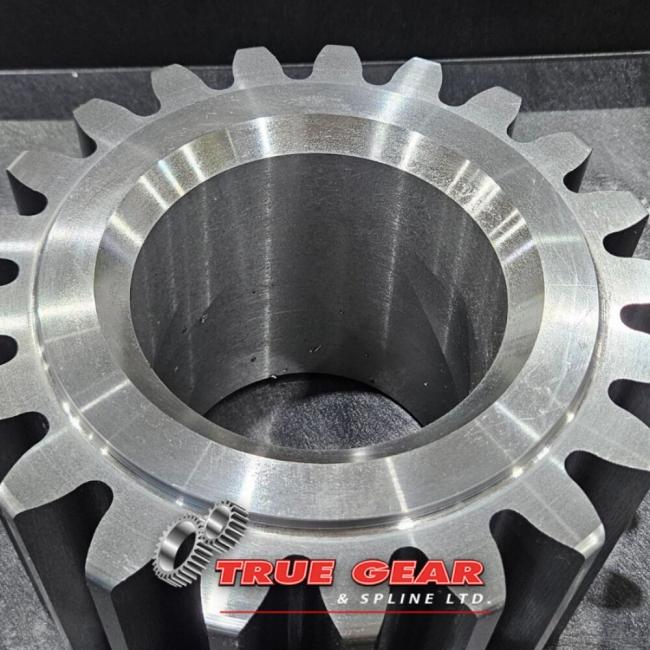
Ground gears are manufactured using a precision abrasive finishing process that corrects heat-treatment distortion and refines tooth geometry to high accuracy classes. They are specified when torque stability, noise control, load distribution, and long-term durability are critical. Understanding accuracy grades, grinding methods, and application demands helps engineers determine when grinding is necessary — and when it may be excessive.
What Are Ground Gears?
Ground gears are gears that undergo a high-precision finishing operation after heat treatment to achieve tight dimensional tolerances and superior surface integrity. After rough cutting operations such as hobbing or shaping, the gear teeth are hardened to improve wear resistance.
Because heat treatment can introduce distortion, grinding is used to remove small amounts of material and restore precise geometry. The result is a gear capable of meeting high AGMA gear accuracy classifications and delivering predictable performance under demanding conditions.
How gear grinding differs from other finishing methods
Traditional cutting methods generate tooth form efficiently but cannot fully eliminate deviations in profile, lead, and pitch after hardening. Finishing methods, such as shaving or honing, improve surface characteristics but typically occur before final hardening or provide limited correction capability.
The gear grinding process, by contrast, is performed after hardening. It allows direct correction of profile errors, lead deviations, runout, and involute variations. Grinding also enables micro-geometry modifications such as crowning and tip relief, which directly influence load distribution and noise performance.
Where ground gears are commonly used
Ground gears are most common in systems where precision directly affects performance outcomes. Automotive transmissions, aerospace assemblies, robotic actuators, industrial speed reducers, and high-speed spindles rely on precision ground gears.
These applications require tight backlash control, consistent torque transmission, reduced vibration, and extended service life. In many cases, the cost of grinding is justified by performance stability and reduced lifecycle maintenance.
The Gear Grinding Process
The gear grinding process is a highly controlled manufacturing operation designed to achieve the final geometry after hardening.
Pre-grinding preparation and heat treatment
Manufacturing begins with a gear blank prepared through turning and facing operations. Teeth are rough cut using hobbing or shaping to near-final dimensions. The gear is then heat-treated, commonly through carburizing and quenching, to achieve the required surface hardness.
Heat treatment increases wear resistance but introduces dimensional distortion. Tooth spacing may shift slightly, and the lead or profile error can increase. Grinding corrects these distortions to restore precise involute geometry.
Profile grinding vs form grinding
Profile grinding generates the tooth geometry by coordinating the CNC motion of the grinding wheel relative to the gear. This method allows high flexibility and is ideal for complex gear designs or lower production volumes.
Form grinding uses a wheel dressed to the exact negative shape of the tooth space. The wheel is fed into each tooth slot individually. This method is efficient for high-volume production of consistent geometries.
Both methods can achieve high AGMA gear accuracy levels when properly controlled.
CNC gear grinding machines
Modern CNC gear grinding machines use multi-axis control to manage profile angle, lead slope, and crown modifications. Digital dressing systems maintain wheel geometry, while temperature-control systems minimize thermal expansion during grinding.
Advanced machines allow intentional micro-corrections such as:
- Lead crowning
- Profile modification
- End relief
- Bias correction
These refinements directly influence contact pattern and transmission error.
Post-grinding inspection and verification
After grinding, gears are inspected using analytical gear measurement systems. Parameters evaluated include:
- Total pitch variation
- Profile deviation
- Lead deviation
- Runout
- Base tangent length
Inspection confirms compliance with AGMA or ISO gear accuracy requirements. For high-performance systems, contact pattern testing may also be performed under load simulation.
Steps: How Ground Gears Are Manufactured
- Gear blank preparation
- Rough cutting or hobbing
- Heat treatment
- Grinding for final profile accuracy
- Inspection and quality validation
Each step builds toward the final performance capability of the gear.
Why Precision Matters in Ground Gears
Precision in gear manufacturing directly affects torque transfer efficiency, vibration behaviour, and durability.
Tooth profile accuracy
Accurate involute geometry ensures correct rolling contact between mating gears. Deviations increase sliding friction and alter load distribution. Grinding minimizes profile error, reducing transmission error during rotation. Lower transmission error improves rotational smoothness and reduces dynamic loading.
Lead accuracy and alignment
Lead deviation affects how the tooth contacts across its face width. If the lead is inaccurate, the load concentrates on one edge, causing premature wear and pitting. Grinding allows controlled lead corrections and intentional crowning to improve alignment under load.
Surface finish quality
Gear surface finish influences lubrication film formation. Rough surfaces disrupt oil film stability, increasing friction and heat generation. Grinding achieves low Ra values, improving lubrication performance and reducing micropitting risk.
Reduced vibration and noise
Noise in gear systems often originates from transmission error and micro-geometry deviations. Precise ground gears reduce these deviations, resulting in smoother mesh and lower acoustic output. In automotive and robotics applications, this can be critical to overall system acceptance.
Checklist: Performance Benefits of Ground Gears
- High torque consistency
- Reduced backlash variation
- Improved contact pattern stability
- Longer operational lifespan
- Lower acoustic output
AGMA and ISO Accuracy Classes in Ground Gears
Understanding AGMA quality levels
AGMA gear accuracy classifications range from lower-quality industrial grades to high-precision levels. Ground gears commonly achieve AGMA Quality 10 through 15.
Higher AGMA numbers indicate tighter allowable deviations in pitch, profile, and runout. For example, moving from AGMA 9 to AGMA 12 significantly reduces permissible total composite error.
ISO gear accuracy classifications
ISO standards provide internationally recognized tolerance grades, often expressed as ISO 3 through ISO 12. Lower ISO numbers represent higher accuracy.
Both AGMA and ISO systems define limits for:
- Profile deviation
- Helix deviation
- Pitch deviation
- Radial runout
When high accuracy grades are required
High-speed gearboxes, aerospace drives, and electric vehicle transmissions often demand high accuracy. In these systems, dynamic forces amplify minor geometric deviations.
High accuracy reduces the dynamic load factor and improves reliability.
Relationship between tolerance and performance
Tighter tolerances reduce transmission error and improve load sharing. However, specifying extremely high accuracy when unnecessary increases cost without proportional benefit.
Engineering evaluation must balance tolerance against functional requirements.
Ground vs Hobbed Gears
Manufacturing process differences
Hobbed gears are cut using rotating hobs that generate tooth form efficiently. They may be used directly after cutting or with minor finishing.
Ground gears undergo a secondary finishing operation after hardening. Grinding corrects distortion and achieves tighter geometry.
Accuracy comparison
Hobbed gears commonly meet AGMA Quality 8–9. Ground gears can achieve AGMA 10–15, depending on design and machine capability.
This difference directly influences backlash stability and dynamic performance.
Cost considerations
Grinding increases cycle time and requires advanced equipment. Tooling costs, inspection requirements, and skilled labour contribute to higher pricing.
The cost must be justified by improved performance, reduced noise, or longer service life.
Application suitability
Hobbed gears are suitable for moderate-speed, moderate-load applications. Ground gears are preferred in high-speed, high-load, or precision-critical systems.
Comparison Checklist
- Required precision level
- Load conditions
- Noise sensitivity
- Operating speed
- Budget constraints
Applications That Require Ground Gears
Automotive transmission systems
Modern transmissions operate under high rotational speeds and strict NVH requirements. Ground gears reduce vibration and ensure consistent torque transfer. Electric vehicles especially benefit from reduced gear noise.
Industrial machinery
High-duty industrial reducers require predictable performance under sustained load. Ground gears improve contact stability and reduce wear over long cycles.
Robotics and automation systems
Robotic motion control demands minimal backlash and precise positioning. Ground gears support repeatability and smooth actuation.
Aerospace and high-speed applications
Aerospace systems operate under extreme rotational speed and load constraints. Precise ground gears help maintain performance under tight tolerance requirements and thermal variation.
Performance Factors Influenced by Grinding
Tooth contact pattern optimization
Grinding enables micro-geometry corrections that optimize tooth contact under load. Proper contact patterns distribute stress evenly.
Gear mesh smoothness
Reduced profile error lowers transmission error amplitude. This results in smoother rotation and improved efficiency.
Load distribution consistency
Uniform contact reduces localized stress. This extends fatigue life.
Long-term wear reduction
Improved surface finish reduces friction and micropitting. Over extended cycles, this significantly improves durability.
When Ground Gears May Not Be Necessary
Low-speed applications
Low rotational speeds reduce dynamic loading. In such cases, hobbed gears may provide adequate performance.
Moderate tolerance requirements
If AGMA Quality 8–9 satisfies functional needs, grinding may not deliver proportional value.
Budget-driven decisions
Grinding adds cost. For non-critical systems, the cost-to-benefit ratio may not justify precision finishing.
Alternative finishing methods
Honing, lapping, or shaving can improve surface finish sufficiently for some applications.
Checklist: Evaluating the Need for Ground Gears
- Define the required accuracy class
- Assess load and speed conditions
- Determine the acceptable noise level
- Review lifecycle expectations
- Compare cost-to-performance ratio
Conclusion – Matching Ground Gear Precision to Application Needs
Balancing performance and cost
Ground gears provide measurable improvements in geometry, torque stability, and noise control. However, precision should align with performance requirements rather than assumptions.
Engineering-driven selection
Specifying ground gears should follow the evaluation of load, speed, vibration sensitivity, and lifecycle expectations.
Importance of manufacturing capability
Achieving high AGMA gear accuracy requires advanced CNC grinding equipment, experienced operators, and rigorous inspection protocols. Manufacturing capability determines whether design intent translates into real-world performance.
True Gear & Spline Ltd. in Cambridge, Ontario, is a one-stop destination for all your gear manufacturing needs. Our state-of-the-art facility is equipped with the latest technology to manufacture flawless gears. The decades of experience and a skilled workforce make us truly the best in Ontario’s gear manufacturing scene. Call 519-653-1301 to get a free quote today. We also manufacture sleeve couplings and splined shafts.
FAQs
What are ground gears used for?
They are used in high-speed, high-load, and precision-sensitive systems requiring tight tolerance control.
How are ground gears different from hobbed gears?
Ground gears undergo a post-heat-treatment abrasive finishing process to correct distortion and refine geometry.
Why are ground gears more precise?
Grinding removes minimal material with controlled abrasives, achieving tighter tolerances than cutting alone.
Do ground gears reduce noise and vibration?
Yes. Improved profile and lead accuracy reduce transmission error, lowering vibration and acoustic output.
When should engineers specify ground gears?
When performance requirements demand high AGMA gear accuracy, consistent torque transmission, low backlash variation, and controlled noise characteristics.