

Toll Free:
1-877-270-9985, Phone:
519-653-1301, Fax:
519-653-2253
A spiral bevel gear can be a valuable addition to industrial gearboxes and other applications where noise and vibration need to be at a minimum. In this blog, we explain everything, including performance, key features, performance, trade-offs, and applications of spiral bevel gears. If you are considering getting spiral bevel gears, read this blog till the end to make an informed decision.
A spiral bevel gear is a cone-shaped gear with curved and oblique teeth. The teeth follow a spiral path to the pitch cone’s apex. A spiral bevel gear is used to transmit torque between two intersecting shafts, primarily at 90°. One of the major differences between straight and spiral bevel gears is that the latter facilitates smooth, gradual engagement of the gear teeth.
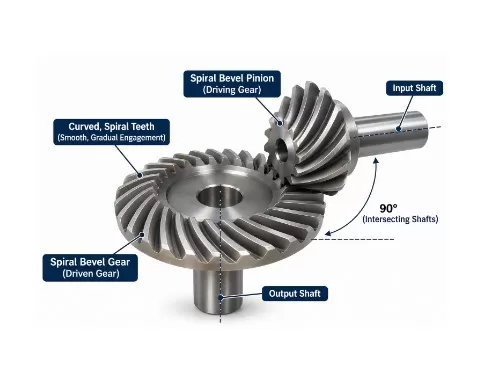
Spiral bevel gears usually operate at a steep plane. A spiral bevel gear consists of a crown wheel or gear wheel (driven gear) and a smaller pinion (driver gear). They work by having the curved teeth of the pinion and gear wheel gradually engage with each other. During this process, the torque or rotational force is transferred from the former to the latter.
Spiral bevel gear features distinct and significant design features from that of its straight counterpart. Here are some key features of spiral bevel gear design, making them ideal for smooth, uninterrupted torque transmission:
Spiral bevel gears also generate radial and axial thrust that is accounted for during manufacturing to ensure precise tolerances. While straight and spiral are both important types of bevel gears, the latter has an edge due to the curved, oblique teeth and gradual engagement.
There are two sides to a coin, and spiral bevel gears are no different. While considered one of the most efficient gears, there are certain trade-offs that you must be aware of. The complex design and manufacturing process means there are certain factors that must be accounted for to ensure precise torque transfer. So, here is all you need to know about the advantages and trade-offs of spiral bevel gears.
Design Aspect | Advantages | Trade-Offs and Engineering Considerations |
| Tooth Engagement | Curved teeth provide gradual engagement, reducing impact loads. | Requires precise tooth geometry and alignment. |
| Noise and Vibration | Operates more quietly and smoothly than straight bevel gears. | Performance depends on accurate installation and lubrication. |
| Load-Bearing Capacity | Multiple teeth can share the transmitted load, supporting higher loads. | Actual load capacity depends on gear dimensions, materials and operating conditions. |
| Power Transmission | Efficiently transfers torque between intersecting shafts, typically at 90°. | Generates axial and radial thrust that requires suitable bearings. |
| Operating Speed | Suitable for high-speed applications due to smoother tooth engagement. | High-speed operation requires proper lubrication, balancing and heat management. |
| Manufacturing | Precision-cut teeth offer consistent performance and reliable operation. | More complex and expensive to manufacture than straight bevel gears. |
| Maintenance | Durable construction can provide a long service life under suitable operating conditions. | Requires regular lubrication and inspection to minimize wear. |
Spiral bevel gears are widely sought after for a wide range of applications, including in automobiles, heavy machinery, and aeroplanes. This popularity can be attributed to the advantages of spiral gears, such as:
Smooth Operation
Spiral bevel gears offer smoother, quieter operation with reduced noise and vibration compared to many other gear types. This particular advantage makes the gear ideal for applications where noise or vibration can compromise the output. The smooth operation can be attributed to the gradual engagement of the teeth, made possible by the curved, oblique teeth.
High Load Capacity
The design of the spiral bevel gear’s teeth means multiple teeth are engaged at the same time. This facilitates an even load distribution, allowing the gear to bear higher loads without premature wear and tear.
Ideal For High Speed Applications
The high load capacity of spiral bevel gears doesn’t come at the cost of compromised speed. The progressive engagement of spiral bevel gears makes them suitable for applications requiring relatively high rotational speeds.
If you are an engineer considering sourcing spiral bevel gears for your specific application, you must account for their limitations such as:
Higher Manufacturing Cost
The complex geometry translates to higher manufacturing costs, as it requires access to specialized machinery and skilled workers.
Radial and Axial Thrust
Spiral bevel gears generate radial and axial thrust that must be accounted for. It is important to mitigate thrust with the help of bearings and fittings to ensure uninterrupted operation.
Relatively Higher Maintenance
Due to the complex geometry and greater surface area engagement, spiral bevel gears must be properly lubricated. Regular inspection and maintenance are also important to prevent premature wear and tear.
Comparison Factor | Spiral Bevel Gears | Straight Bevel Gears |
| Tooth Geometry | Have curved, angled teeth that follow a spiral pattern along the pitch cone. | Have straight teeth that extend towards the apex of the pitch cone. |
| Tooth Engagement | Teeth engage gradually, with overlapping contact that promotes smoother power transmission. | Teeth engage more abruptly, resulting in a more sudden transfer of load. |
| Noise and Vibration | Generally offer quieter operation with reduced vibration, particularly at higher speeds. | Tend to produce more noise and vibration, especially at higher operating speeds. |
| Manufacturing Complexity | More complex to manufacture and require specialized machinery and precise machining. | Simpler to manufacture, with generally lower production costs. |
| Selection Considerations | Suitable for applications requiring smooth operation, higher speeds and consistent power transmission. | Suitable for simpler, lower-speed applications where cost-effectiveness and ease of manufacturing are priorities. |
Note: Actual performance depends on gear design, materials, manufacturing accuracy, loading and operating conditions. Neither type is automatically more efficient or suitable for every application.
The primary difference in tooth geometry between the spiral and straight bevel gear is that the former has curved, oblique teeth, and the latter has straight teeth that join together at the pitch cone of the apex. Due to the teeth shape and geometry, spiral gears promote gradual engagement, and straight gears promote sudden engagement.
Which gear to choose depends on a wide range of factors, including the operating environment, intended application, and expected performance. Engineers must choose spiral bevel gears for high-speed, high-precision, and high-load applications.
Straight bevel gears are more suitable for applications where cost-effectiveness and ease of manufacturing are more important. Consult an experienced gear manufacturer if you aren’t sure which gear is more suitable for your specific applications.
Straight and spiral gears have their own features and advantages. Carefully consider all factors before making the right decision.
Spiral bevel gears are used in a wide range of applications where quiet and smooth operation are essential. The gradual and multi-tooth engagement promotes high-speed, high-precision torque transfer between intersecting shafts. Here are some areas where spiral bevel gears are commonly used.
Application | Power Transmission Requirements | Relevant Gear Characteristics |
| Automotive differentials | Transfer engine torque to drive wheels while allowing them to rotate at different speeds | Smooth tooth engagement, quiet operation and efficient torque transfer |
| Industrial gearboxes | Transmit high torque between intersecting shafts under continuous operation | High load capacity, durability and precision |
| Pumps and compressors | Maintain consistent power transmission at varying speeds and loads | Smooth operation, reduced vibration and reliable performance |
| Cooling towers | Transfer power from motors to fan assemblies, often under continuous operation | Efficient power transmission, low noise and resistance to wear |
| Mining equipment | Handle heavy loads, high torque and demanding operating conditions | High strength, durability and resistance to mechanical stress |
| Marine propulsion systems | Transfer power through angled drive arrangements in confined spaces | Compact design, high torque capacity and smooth operation |
A differential system is crucial for the safety and performance of a car. It allows engines to power the drive wheels while letting them spin at different speeds. Spiral bevel gears are a crucial component of differential systems.
The unmatched precision, load capacity, speed, and efficiency make spiral bevel gears ideal for heavy-duty applications. Their ability to perform in demanding operating conditions is extraordinary. Spiral bevel gears are found in pumps, cooling towers, mining equipment, and industrial gearboxes.
The selection of the gear depends on the operating environment and other factors such as expected load, speed, and tolerance to noise and vibration. For high-speed, low-noise applications, spiral bevel gears are the better choice and for applications demanding low-cost, low-speed operations, straight bevel gears are a better choice. Learning about bevel gear applications helps engineers make the right choice.
Designing and manufacturing spiral bevel gears involves many nuances that must be carefully navigated. Even the smallest deviation from the original plan can have detrimental effects on torque transmission. Here are some of the most important factors that matter in spiral bevel gear design and manufacturing.
Spiral bevel gear geometry is complex, to say the least. The geometry is influenced by factors such as load capacity, speed, as well as the shaft/bearing arrangement. Spiral angle, tooth size, gear ratio, and shaft angle are important factors that matter in spiral bevel gear design and manufacturing.
No matter how much time you spend on planning and designing, it only pays off if the plan is materialized through precision manufacturing. To ensure seamless tooth contact, manufacturers use CNC machining and have quality checks in place.
Proper bevel gear assembly and shaft alignment are essential for reliable spiral bevel gear operation. Incorrect positioning can lead to uneven tooth contact, excessive friction, noise, and premature wear. Suitable bearings must be used to mitigate radial and axial thrust. Lubrication is also an important parameter for longevity.
The lubricant must be appropriate for the gear material, operating speed, and load to minimize. Proper bevel gear assembly, alignment, and lubrication are key to uninterrupted torque transmission.
Selecting the right spiral gear is essential for maximum efficiency. What sounds like a straightforward process is actually quite nuanced. If you are in the market for spiral bevel gears, you need to be armed with the right information. Here is a step-by-step guide on how to select the right spiral bevel gear.
You must convey the application requirements clearly to the gear manufacturer. Highlight important factors such as torque, speed, shaft angle, gear ratio, and operating environment. Communicating these operating requirements at the beginning itself avoids confusion.
There’s no point in conveying the application requirements if the manufacturer does not have the capability to meet them. Evaluate the manufacturer’s or supplier’s capabilities to make sure your requirements can be met without any delays or compromise in quality.
Custom bevel gear manufacturing is the ideal option when off-the-shelf ones are not enough to meet your specific requirements. Bevel gear cutting requires access to sophisticated machinery and skilled labour. Work only with a trusted gear manufacturer to ensure a dependable torque-transmission solution. Custom bevel gears are particularly useful for specialized machinery, automotive systems, and industrial equipment.
Spiral bevel gears offer excellent performance, especially in applications that demand low vibration, low noise, high speed, and high torque transfer. The complex tooth geometry of spiral bevel gears makes them relatively more complicated to manufacture. However, the right gear manufacturer with ample experience and expertise can manufacture the perfect custom spiral bevel gear for your applications.
A spiral bevel gear is used to transmit torque between two intersecting shafts, mostly at a 90 ° angle. Its curved teeth provide smooth, quiet, and efficient torque transmission, even at high speeds.
While both are conical, the spiral bevel gear has curved, oblique teeth, and the straight bevel gear has straight teeth tapered toward the apex. Due to the design, spiral bevel gears offer gradual engagement, while the straight bevel gear’s engagement is more sudden.
Smooth operation, gradual engagement, less vibration and noise, more power, higher speed, and an impressive load capacity are the main advantages of spiral bevel gears.
Yes, spiral bevel gears require suitable gear lubricants in appropriate amounts to ensure uninterrupted operation. Follow the manufacturer’s guide to ensure you get the right lubricant for spiral bevel gears.
Consider the application requirements, the manufacturer’s manufacturing capability, the budget, and the operating environment
Request a quote today and discover why industries across North America trust us for their gear manufacturing needs.